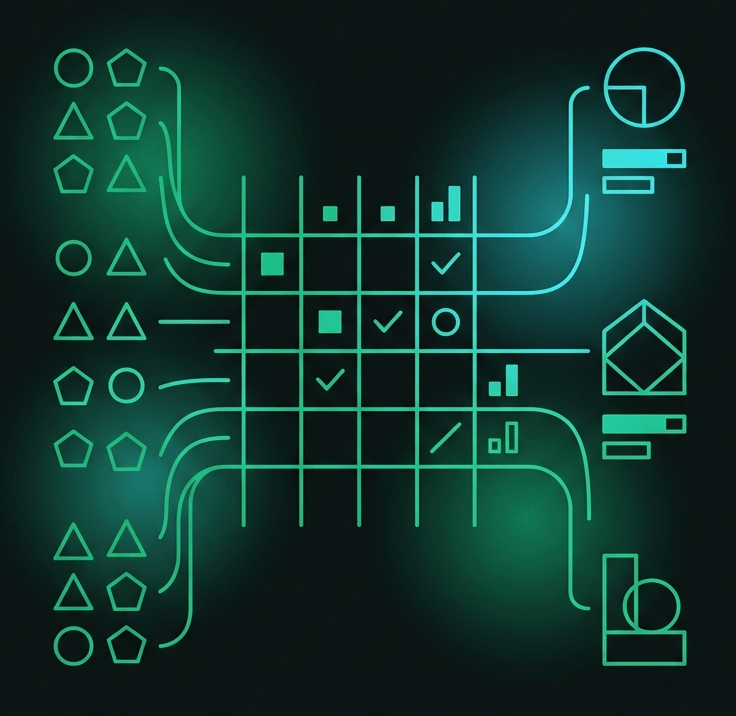
The problem it solves
AI systems are easy to fool yourself about. A model gives an impressive answer to the handful of questions you happen to try, the demo goes well, and you assume it works. Then real users send inputs you never tested, and it fails in ways you never saw.
The deeper problem is change. AI applications are tweaked constantly: prompts get revised, models get swapped, retrieval gets adjusted. Every one of those changes can silently improve one thing and break another. Without a way to measure quality, you cannot tell whether a change helped, introduced a regression, or just made the demo look better. Evaluation turns “it seems fine” into a testable question with an answer, and that is what makes steady improvement possible instead of guesswork.
How it works
Evaluating an AI system is different from testing ordinary software, and understanding why is the key to the whole idea.
There is often no single right answer. Conventional software testing checks a fixed expectation: given this input, the output must be exactly this. But an AI model may phrase a good answer many different ways, and whether an answer is “good” often depends on context. So evaluation usually estimates quality across many cases rather than asserting one exact result, and its findings require interpretation, not just a pass or fail.
There are a few ways to score outputs. Some checks are mechanical and exact: is the output valid, does it contain the required field, does it match a known answer. For open-ended quality, two other methods are common: having humans judge the outputs, which is the gold standard but slow, and using another AI model as an automated judge against clear criteria, which scales far better and is widely used, though the judge itself has to be checked.
You test before and after release. Offline evaluation runs a fixed set of test cases before a change ships, to catch regressions early. Online evaluation watches real usage after launch, to find problems that no test set anticipated. Together they form a loop: measure, change something, measure again, and only keep the change if the numbers hold up.
The throughline is replacing impressions with measurement. Evaluation is what lets a team say, with evidence, that today’s system is better than yesterday’s, rather than merely hoping so.
A concrete example
Suppose you run an AI assistant that answers questions from your company’s documents, and you want to improve its prompt.
Without evaluation, you change the prompt, try a few questions, and it seems better, so you ship it, and only later notice it now gets a whole category of questions wrong. With evaluation, you keep a set of representative questions with known good answers. You run the old prompt and the new one against all of them, compare the scores, and see clearly whether the change helped or hurt before any user is affected. The decision is made on evidence, not on a good feeling from three examples.
How it connects
Evaluation is how you measure and control problems like hallucination, and how you safely change a prompt, a RAG setup, or an agent without breaking what already worked. It is the measurement layer under responsible, reliable AI.
It runs through every building role. An AI/LLM Developer writes and runs evals, an AI Solutions Architect designs systems to be measurable, and an AI Product Manager defines what “good” even means for the product, which is where evaluation begins.