The problem it solves
The first generation of AI coding help was autocomplete: tools that suggested the next line based on what you had just typed. Useful, but limited to the cursor. You still had to know which files to change, make the changes across all of them, run the tests, read the failures, and fix what broke.
Claude Code targets that whole loop, not just the next line. The problem it solves is the gap between describing a change in plain language and having it actually made, correctly, across a real project. Instead of you orchestrating the model file by file, the tool takes a task, works out what needs to change, makes the changes, checks its work, and reports back. It shifts the developer from typing every edit to directing an agent that carries them out.
How it works
Claude Code is a concrete, everyday example of an agent, the general concept, applied to software.
It reads the whole project. Rather than making you paste in the relevant files, it explores the codebase itself, mapping structure and dependencies to understand how the pieces fit before it acts. This is why it can make changes that span many files coherently.
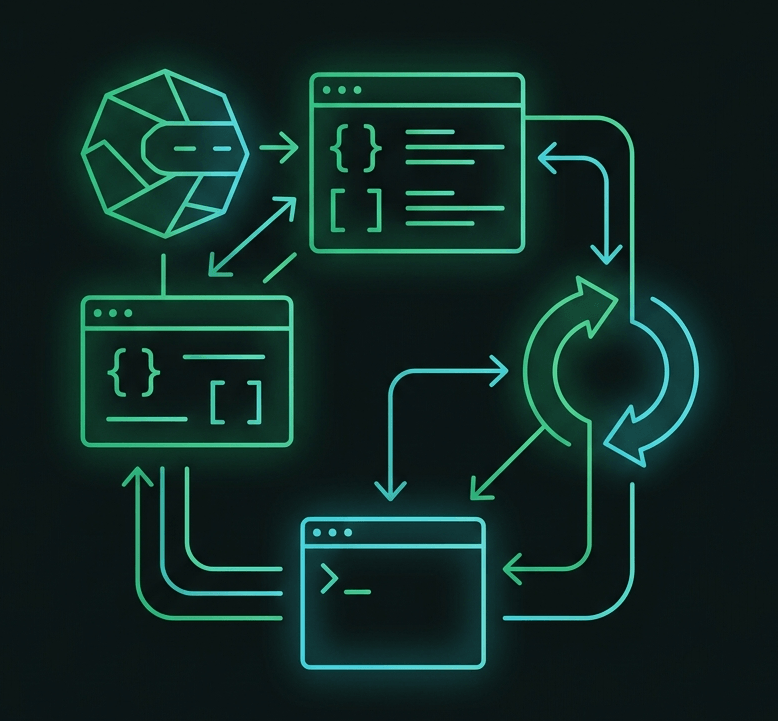
It runs an agentic loop. Given a task in plain language, it plans an approach, edits files, runs commands and tests, reads the results, handles failures, and iterates, deciding each next step based on what just happened, until the task is complete. That decide-act-observe cycle is exactly the agent loop, here pointed at code.
It works where developers already work. It runs in the terminal, in the desktop app, and inside common IDEs through extensions, and it connects to external tools and data through MCP, the same protocol described elsewhere in this library. It can read issues, edit code, run tests, and handle version-control workflows in one place.
Because it can act, not just suggest, the same safety thinking that applies to any agent applies here: it operates with real access to your files and shell, so working on a branch, reviewing its changes, and keeping consequential actions under human control are part of using it well.
Specific details, exact install methods, supported IDEs, performance figures, and pricing, change often, so for anything current the authoritative source is Anthropic’s own documentation. What is stable is the shape of the tool: a codebase-aware coding agent that runs the full edit-test-iterate loop.
A concrete example
Suppose a project needs a new field added to a form, saved to the database, and shown on a summary page, a change that touches several files.
With autocomplete, a developer makes each edit by hand, jumping between the form, the data layer, and the display, running tests along the way. With Claude Code, the developer describes the change in plain language. The agent locates the relevant files, makes the edits across all of them, runs the tests, fixes what does not pass, and reports what it did, for the developer to review. The work still gets reviewed by a person; what changed is who moved through the files.
How it connects
Claude Code is the clearest working example of an agent in this library: it runs the agent loop over a real codebase. It depends on tool use to act on files and run commands, and it uses MCP to reach external systems.
It is central to one role and reshaping another. An AI/LLM Developer uses tools like this daily and needs to know where generated code requires careful review. And it is part of why the AI Solutions Architect and senior engineering roles increasingly emphasize judgment, specifying, reviewing, and designing, as writing each line by hand becomes less of the job.